// SCREEN MONITORING & AUTOMATED OUTREACH · IRELAND, UK & EUROPE
Focal Media Heartbeat
Monitors thousands of screens around the clock and fixes most faults before anyone notices
Built for Focal Media, one of Ireland's leading digital signage operators. Heartbeat texts the venue, phones the contact with an AI agent, diagnoses the fault, and dispatches an engineer only when one is genuinely needed.
// THE CHALLENGE
When Screens Go Dark, Nobody Knows
Focal Media operates a digital signage estate of over 9,000 screens across Ireland, the UK and Europe for more than 40 national client brands. Without a purpose-built monitoring system, every outage was a guessing game — and the gap between a screen failing and anyone noticing was measured in weeks.
A Dark Screen Could Go Unnoticed for Weeks
A screen that's been dark for a week is advertising revenue lost and a client relationship damaged — and traditionally nobody finds out until someone walks past it.
No Response from Site Contacts
Phone calls to site contacts went unanswered and voicemails were ignored, leaving screens down with no way to reach the person who could actually fix the issue.
Engineers Sent for Nothing
Without a way to diagnose a fault remotely, every unresolved outage risked a site visit — and the callout cost that comes with it — for problems as simple as a power-cycle or a changed Wi-Fi password.
After-Hours False Alarms
A screen switched off overnight in a closed pub looked identical to a genuine outage. Flat 24/7 monitoring generated noise, alert storms, and uptime figures that made everyone look bad.
Two Platforms, No Single View
The estate runs across multiple signage platforms (Scala and OnSign/DAMOC). Checking each separately meant no one number for network health and no consistent way to triage.
No Audit Trail
There was no record of what action was taken for each incident, when it was taken, or what the outcome was — making it impossible to improve the process or prove responsiveness to clients.
// OUR SOLUTION
It Fixes Things — It Doesn't Just Alert
Most monitoring tools send an email and stop. Heartbeat runs the whole escalation on its own — texting the venue, phoning the contact, diagnosing the fault, and only then involving a person. Every step is timed against the client's agreed service level and confined to the venue's opening hours. No 3am texts.
Automated Escalation Flow — No Operator Involvement
SMS #1
Initial Alert
SMS #2
Follow-Up
AI Voice Call
Conversational Diagnosis
Approval Gate
Before Any Spend
Engineer Dispatch
Only If Genuinely Needed
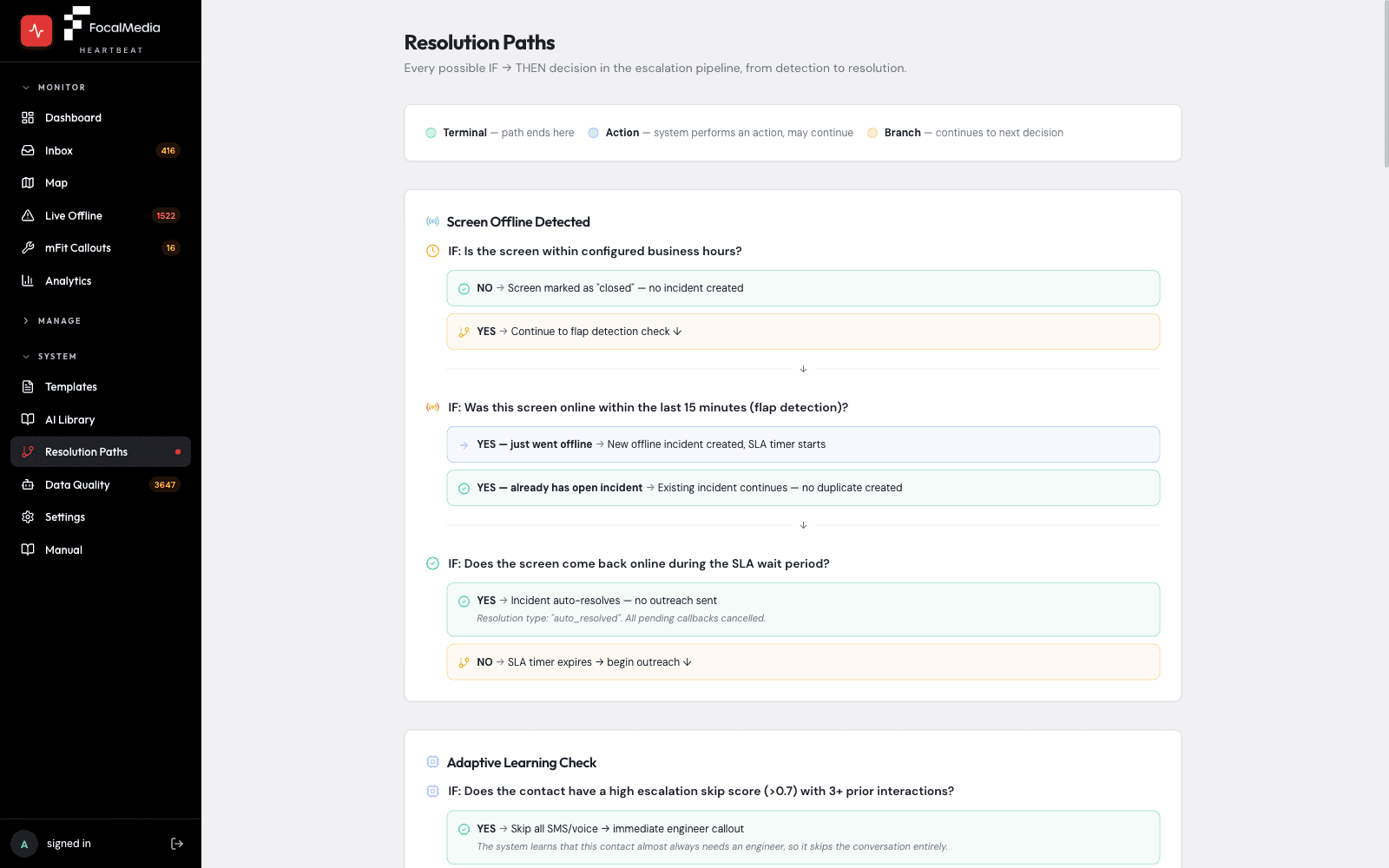
Resolution Paths — every decision in the escalation pipeline, from detection to resolution
Business-Hours-Aware Monitoring
Every screen across both signage platforms (Scala and OnSign/DAMOC) watched from a single view, with each venue's real opening hours built in — including bank holidays, seasonal hours, and content rules like alcohol advertising windows. A screen that's off overnight in a closed pub is never treated as a fault.
Classified by Behaviour, Not Just Up/Down
Problem screens are typed and triaged — awaiting outreach, active outreach, chronic flapper, flaky. A screen that drops out twice a day is a different problem from one that's been dark for a week, and Heartbeat treats them differently. Flapping units are suppressed rather than generating alert storms.
Two-Way SMS That Understands Replies
The system reads what the contact actually says and branches accordingly — it can tell "it's working now" from "I can't find the router." Messages are written for the specific screen and situation, referencing where the unit sits in the venue rather than sending generic template text.
An AI Voice Agent That Diagnoses
Not a robocall or an IVR menu — a conversational agent that phones the contact, asks diagnostic questions, and walks them through fixes like power-cycling a media player. Afterwards it records whether an engineer is needed, whether it hit voicemail or a wrong number, whether a callback was asked for, and why.
A Knowledge Base That Teaches Itself
Site-specific knowledge is stored against each screen, venue and client — "the media player is in the shop next door", "ask for the duty manager" — and read live during calls and texts. New facts discovered mid-conversation are captured as draft knowledge, and every entry tracks how often it's been cited and how often it led to a resolution. Guidance that helps gets promoted; guidance that doesn't gets flagged.
Engineer Dispatch with Cost Control
Callouts are raised automatically in the mFit field-service system and reconciled two-way every five minutes, so the list is always current. For clients who want it, a quote approval gate means no engineer is dispatched — and no cost incurred — until a human approves, from an email link, the dashboard, or the screen's own page.
Honest Uptime Reporting
Uptime measured against when each venue is actually open, not a flat 24/7 figure. Per-client health scorecards, incident trends, resolution mix, screen reliability rankings, and branded PDF Network Health Reports carrying the client's own logo, generated and emailed on a weekly schedule.
Operator Inbox
Everything that needs a human eyeball, prioritised — quote approvals awaiting sign-off, engineer jobs needing linking, screens whose opening hours look misconfigured. Alongside it: a live control-room dashboard, a full map of the estate, and a permanently auditable log of every text and call with transcripts.
Automated outreach, AI-generated messaging and the self-learning knowledge base are enabled client by client — nobody gets texted before their account is ready.
// PROOF POINT
73 Minutes. Zero Human Involvement.
A real, recent incident from the live system. From the moment the screen went offline to an engineer callout raised for approval, no operator touched it.
T+0
Screen Goes Dark
A screen misses its expected check-in. Heartbeat confirms the venue is open, rules out a known content rule, and opens an incident.
SMS #1
The Venue Is Texted
A message written for this specific screen asks the site contact whether anything has changed — power, WiFi, building works.
SMS #2
Follow-Up Sent
No reply. Heartbeat sends a second message, still inside the venue's opening hours and inside the client's agreed service level.
AI Call
The AI Agent Phones
A conversational agent calls the contact, talks through the symptoms, and establishes that the screen is physically fine but has lost network connectivity.
T+73
Engineer Callout Raised for Approval
Hardware fault ruled out, root cause identified, callout raised in mFit and queued for human sign-off before any cost is incurred.
Texted twice, phoned the contact, diagnosed a network fault, ruled out a hardware failure, and had an engineer approved inside 90 minutes — while the ops team got on with something else.
// BUSINESS IMPACT
From Reactive to Proactive
Heartbeat didn't just speed up incident response — it changed how the operations team works entirely, at a scale no manual process could reach.
Screens Monitored
Across Ireland, the UK and Europe — every one on a ~15-minute heartbeat cycle
Client Brands
National retail, pharmacy, hospitality and drinks names, each with their own service level
Alert to Engineer Approved
One real incident: detection, two texts, an AI phone call, diagnosis and callout — completed unattended
“Heartbeat means we know about a screen going down before our clients do — and in most cases, it's already being dealt with automatically.”
Focal Media
Digital Signage Operations, Ireland
// TECHNICAL ARCHITECTURE
<Technical Architecture />
A multi-service architecture stitched together to deliver hands-free incident detection, outreach, and resolution tracking at scale.
Heartbeat Polling Engine
Integrates with Scala and OnSign/DAMOC servers for automatic player discovery and continuous polling on a ~15-minute cycle. A screen going dark is detected within minutes of its expected check-in.
Supabase Backend
Database, authentication, edge functions, and row-level security. Every outreach attempt, response, and outcome stored with a full audit trail — every text and call retained with transcripts.
Business Hours Engine
Google Places API seeds opening hours per site, layered with per-venue overrides for bank holidays, seasonal hours, one-off closures and content rules. Uptime is measured against when a venue is actually open.
Knowledge Layer
Structured site knowledge — when to raise a topic, suggested phrasing, what to do if the answer is yes, when to stop troubleshooting — retrieved live during calls and texts, with safety rules taking precedence over everything else.
mFit Two-Way Sync
Callouts are raised into the mFit field-service system and reconciled every five minutes, so jobs closed in mFit close here automatically. Engineer job reports are analysed by AI to classify root cause.
Analytics & Reporting
Incident trends, resolution mix, per-client scorecards, screen reliability rankings, and recurring-issue themes — plus branded PDF Network Health Reports generated and emailed on a weekly schedule.
Plain-English Query Layer
Ask about a single screen or the whole network in natural language and get an answer streamed back in seconds, grounded in current data rather than a stale export. Currently internal-facing.
Safeguards & Access Control
Per-client opt-in for automated contact, approval gates before any spend, human-review flagging when a conversation needs a person, role-based access with a display-only mode for wallboards, and a full audit trail of every automated action.
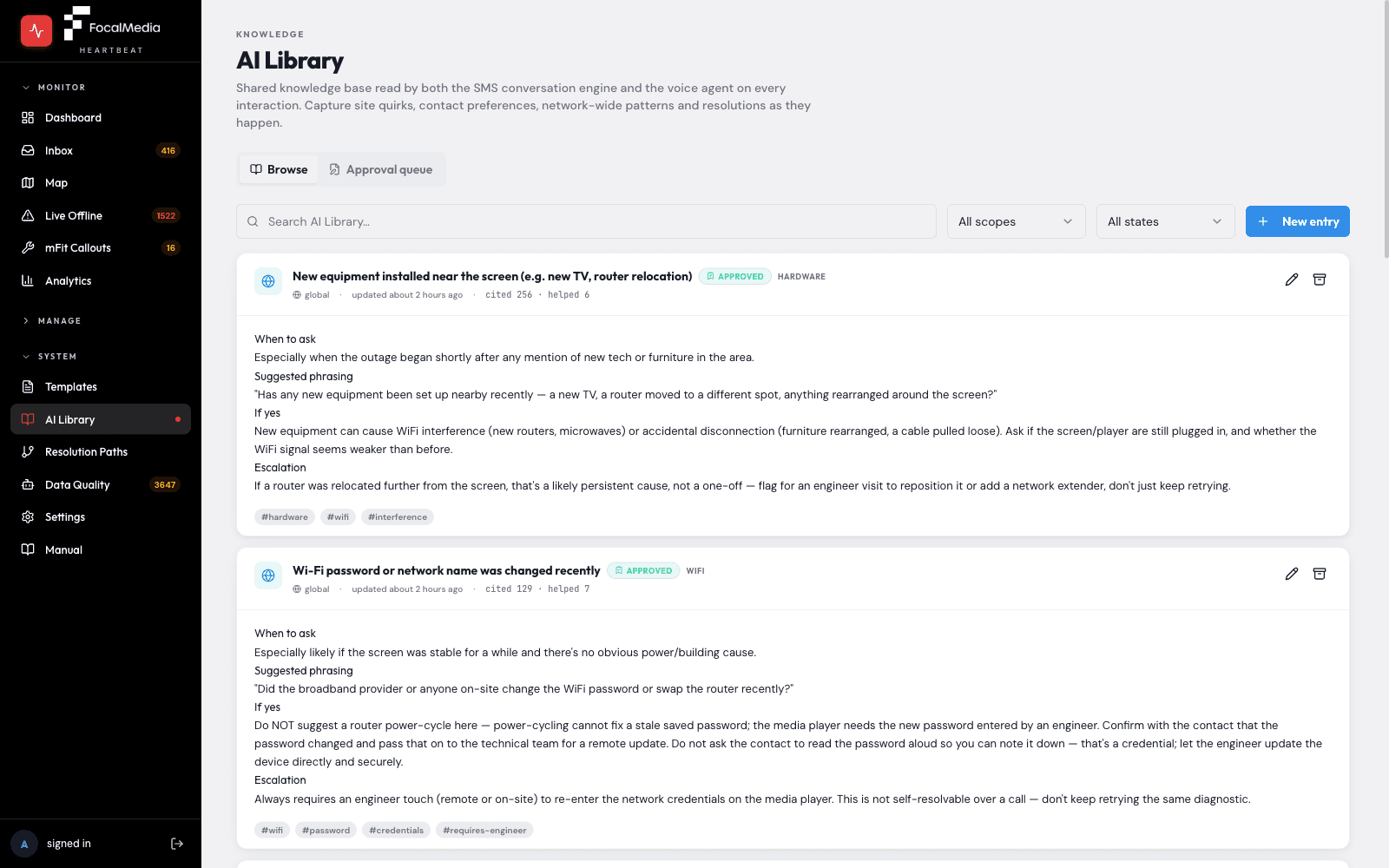
The AI Library — read by both the SMS engine and the voice agent on every interaction
Integrations & Tech Stack
// RESULTS
Uptime You Can Prove
Heartbeat turned an invisible problem into a managed, measurable process — with outcomes the whole team, and every client, can see.
Weeks Down to Minutes
The gap between a screen failing and someone knowing about it closed from weeks to minutes — and a response is already under way before anyone has noticed the screen is dark.
Most Incidents Resolved Before an Engineer
The majority of incidents close at the SMS or AI-call stage. Engineers are dispatched only once the simple fixes have been ruled out by an actual conversation.
Costs Approved, Not Discovered
The quote approval gate means no callout is booked and no cost incurred until a human signs it off — from an email link, the dashboard, or the screen's own page.
Uptime You Can Defend
Business-hours uptime measured per venue gives clients a fairer, more honest number than a flat 24/7 figure — and per-client scorecards to back it up.
The System Gets Smarter Per Venue
Knowledge learned on one call is used on the next, and every entry is scored on how often it's cited and how often it actually led to a resolution — one entry has been cited over 250 times.
Ops Team Freed from Firefighting
The team shifted from reactive manual monitoring to an operator inbox of exceptions — everything that genuinely needs a human eyeball, prioritised, and nothing that doesn't.
// NEXT STEPS
Running a Network Where Uptime Matters?
Whether you operate a screen network, a field service operation, or any business where downtime costs money — let's talk about what intelligent monitoring could do for you.
Minutes
To Detection
Hands-Free
Diagnosis & Escalation
Approved
Before Any Spend